In this article
Question: What does old stack mean in web development?
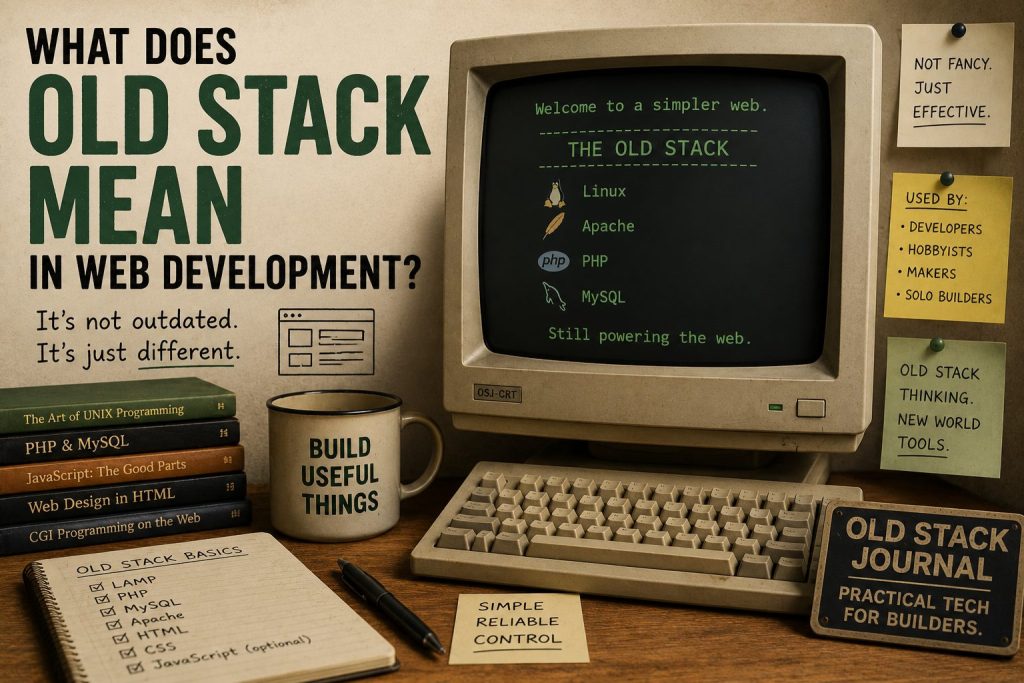
An old stack is a practical web development setup built around mature, well-understood tools instead of whatever is newest this month. For Old Stack Journal, that usually means PHP, MySQL, Apache, WordPress, cron jobs, server-rendered pages, simple hosting, and workflows a solo builder can understand, debug, and maintain.
Old stack doesn’t mean abandoned
Old stack does not mean dead stack, broken stack, or stuck-in-2008 stack. It means the core pieces have been around long enough that the sharp edges are mostly known.
A lot of solo builder work is not about chasing the newest framework. It is about making a form submit, saving useful data, showing a page quickly, sending an email, processing a webhook, logging an event, and being able to fix the thing when it misbehaves.
Old-stack tools are often good at that. They may not look exciting in a launch post, but they have docs, hosting support, cheap servers, years of forum answers, and a large pile of boring solved problems behind them.
What usually counts as old stack?
For me, the phrase points toward practical web foundations:
- PHP and MySQL
- Apache or Nginx
- WordPress when publishing or admin workflows matter
- simple server-rendered pages
- cron jobs for scheduled work
- plain HTML, CSS, and small JavaScript where needed
- normal VPS or shared hosting instead of a pile of managed services
That does not mean every project should use exactly those tools. It means the default bias is toward tools that are easy to reason about, easy to host, and easy to hand back to yourself three months later when you have forgotten half the details.
I wrote more about this in LAMP Is Still Enough for Most Web Projects and Not Every Side Project Needs a Modern JavaScript Stack. The point is not nostalgia. The point is choosing enough stack for the job.
Why old-stack tools work well with AI coding
One reason old-stack development feels useful again is that AI coding tools often work better when the project is easy to describe.
A small PHP app with a few files, a clear database table, and obvious routes is easier to feed into an assistant than a sprawling modern build system with generated code, invisible conventions, and five layers of tooling. The assistant still needs review. It still makes mistakes. But the work is easier to inspect.
That is the part people skip when they talk about AI-assisted coding. The stack affects how much context the AI needs, how many guesses it has to make, and how easy it is for you to catch a bad answer.
That is the “token tax” problem. A stack can be technically impressive and still expensive to explain over and over again. I wrote about that in The Token Tax of New Tech.
Old stack is not anti-modern
Using mature tools does not mean refusing modern ideas.
You can still use APIs, webhooks, queues, AI assistants, good design systems, deployment workflows, and observability. The difference is that the core app does not have to become a museum of everyone else’s architecture choices.
For example, Automation Receipts is an old-stack-shaped idea applied to modern automation. A workflow runs, something happens, and the app leaves behind a readable record. That is not a fashionable architecture pattern. It is just useful.
The same applies to WordPress. A lot of people treat WordPress as old because it has been around for ages. But as a publishing surface, admin UI, plugin platform, and workflow hub, it is still a very practical place to build small tools.
Where old stack is a bad fit
There are times when old stack is the wrong call.
If you are building a real-time collaborative editor, a complex frontend product, a massive API platform, or something with heavy mobile-app expectations, you may need a different setup. If your team already has deep experience in a modern JavaScript stack and a good deployment path, using that stack can make sense.
Old stack is not a religion. It is a bias toward tools that solve the actual problem without adding too much machinery around it.
The mistake is not using React, Next, Laravel, Rails, serverless, or anything else. The mistake is reaching for a stack because it feels current, then spending most of the project fighting build steps, auth glue, deployment surprises, and context loss.
Who this helps
Old-stack thinking helps solo builders, small agencies, WordPress people, practical developers, and non-programmers using AI tools to build small apps.
It is especially useful when the project needs to be maintained by the same person who built it. That person might be you, six months from now, opening the code after a long break and trying to remember what on earth you were thinking.
In that moment, boring clarity beats clever architecture.
What I’d do next
If you are starting a small web project, I would not begin by asking, “What is the newest stack?” I would ask:
- What does this app need to do?
- Where will it run?
- Who will maintain it?
- What parts need to be easy for AI to help with?
- What parts need to be easy for a human to review?
Old stack is not about refusing progress. It is about keeping the project understandable enough that progress does not bury you.