In this article
- Sometimes the answer isn’t the real problem
- A better question can be more useful than a faster answer
- The prompt I’d actually use
- What the AI should look for
- Where this works well
- Where it doesn’t help much
- A simple question-first workflow
- Don’t confuse better wording with better thinking
- This is more than prompt polishing
- What I’d do next time I’m stuck
Question: Should you ask AI to improve your question before it answers?
Yes, especially when you’re dealing with a subject you don’t understand well enough to frame properly. Asking AI to expose your assumptions, point out missing context, and suggest better versions of the question can lead to a more useful answer. The trick is to treat the rewritten question as a draft to review, not as proof that the AI suddenly understands the problem better than you do.
Sometimes the answer isn’t the real problem
I posted a small tip on X today: when you don’t know how to ask AI the right question, ask it to help you create the question first.
That sounds like a prompt trick, but I think there’s a more useful idea underneath it. Quite often, the problem isn’t that the AI can’t produce an answer. The problem is that we don’t know enough about the subject to ask for the right thing.
We might use the wrong terminology, skip an important constraint, assume two things are connected when they aren’t, or ask for a solution before we’ve properly described the problem. AI will usually answer anyway. That’s part of what makes it useful, but it’s also part of what makes it risky. A confident answer to a poorly formed question can still send you in the wrong direction.
This comes up constantly in coding, business decisions, research, content planning, and technical troubleshooting. You ask a question that seems reasonable from where you’re standing, but someone with more experience would immediately notice that the question is missing half the setup.
That’s where asking AI to improve the question first can help.
A better question can be more useful than a faster answer
Most people use AI as a direct path from request to answer. You type something, it responds, and you decide whether the result looks useful.
That works well when the task is simple and you already understand the territory. If you want a paragraph rewritten, a list cleaned up, or a piece of code explained, you probably don’t need an elaborate questioning stage.
It’s different when you’re outside your own expertise. In that situation, the wording of the question can hide problems you don’t yet know how to see.
For example, imagine asking:
What’s the best database for my app?
That looks like a normal technical question, but it’s too early. An experienced developer would want to know what the app does, how much data it stores, whether it needs relationships, who maintains it, what hosting is available, how many users it might have, and whether the person building it already knows a particular database.
The useful answer might not be a database name. It might be a better set of questions.
The same thing happens outside development. “What’s the best AI tool for my business?” isn’t really one question. It could mean writing, customer support, coding, research, document processing, meeting notes, image generation, or automation. Until the job is clearer, most answers will be little more than a list of popular products.
The prompt I’d actually use
The original X post included this version:
Before answering, rewrite my question at PhD level. Identify the assumptions I’m making, the context I’m missing, and what an expert would ask instead.
That’s memorable, and it can produce interesting results, but I wouldn’t rely too heavily on “PhD level” as the instruction. More advanced wording isn’t always better wording. Sometimes it just turns a simple question into a denser one.
I’d use something more practical:
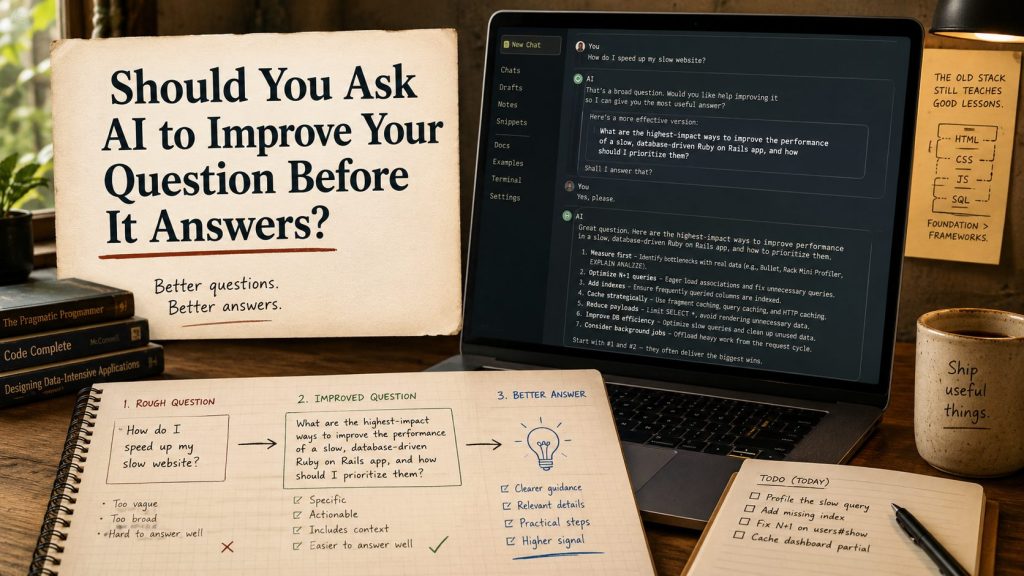
Before answering, help me improve the question. Identify any unclear terms, hidden assumptions, missing context, and important constraints. Then give me three better versions: one practical, one expert-level, and one that challenges my original framing. Don’t answer until I choose a version.
That prompt does a few useful things. It asks the AI to slow down, it separates question formation from answering, and it gives you options rather than pretending there’s one perfect rewrite.
I’d also add this when the subject matters:
Tell me what information you’d need from me before this question can be answered properly.
That last line is often more valuable than asking for a smarter-sounding question. It turns the exchange into a small intake process.
What the AI should look for
When I ask AI to improve a question, I’m usually looking for four things.
The first is unclear language. Words like “best,” “secure,” “cheap,” “fast,” and “scalable” sound precise until you try to make a decision with them. Best for whom? Secure against what? Cheap at what scale? Fast under which conditions?
The second is hidden assumptions. A user might assume they need a mobile app when a simple website would do, or assume they need automation when a manual checklist would be safer. A better question should make those assumptions visible.
The third is missing context. AI can’t account for constraints it hasn’t been given. Budget, skills, deadlines, hosting, existing tools, maintenance capacity, audience, and risk tolerance can completely change the answer.
The fourth is alternative framing. Sometimes the original question points at the wrong layer of the problem. “Which plugin should I install?” might really be “Do I need this feature at all?” Asking AI to challenge the framing can prevent a lot of unnecessary tool hunting.
Where this works well
This approach is most useful when you feel slightly out of your depth but still need to make progress.
It works well for research because AI can suggest missing concepts, competing interpretations, and terminology you may not know yet. It won’t replace proper sources, but it can help you build a more sensible search path.
It works well for debugging because beginners often describe the visible symptom rather than the actual failure. Instead of jumping straight into a patch, AI can help clarify what changed, what was expected, what actually happened, and what evidence is available. That fits the same principle as making a bug smaller before asking AI to fix it: improve the shape of the problem before requesting a solution. See Make the Bug Smaller Before You Ask AI to Fix It.
It also works well for business and workflow questions. If someone asks how to automate a process, the useful first step may be identifying which parts are repetitive, which parts require judgement, and where mistakes would cause trouble. Without that, AI tends to recommend automation because automation was mentioned in the question.
Content planning is another good fit. Instead of asking, “What should I write about?”, you can ask AI to turn the rough idea into several reader questions, identify who each question serves, and point out which versions are too broad or generic.
Where it doesn’t help much
Not every question needs a pre-question workshop.
If you need a straightforward fact, a quick conversion, a grammar fix, or a simple explanation, asking AI to rewrite the question first may just add friction. The point isn’t to make every interaction more elaborate. It’s to use this method when the cost of asking the wrong question is higher than the cost of slowing down.
It’s also a poor substitute for professional advice. Asking AI to improve a legal, medical, financial, or safety-related question may help you organise your thoughts, but it doesn’t make the answer authoritative. In those cases, the improved question may be most useful as something to take to a qualified person.
You should also be careful with impressive personas. Asking what an Olympic mathematician, senior engineer, or famous founder would ask can sometimes produce a fresh angle, but it can also produce theatre. The answer may sound more sophisticated without being more accurate.
That’s why I prefer asking for assumptions, missing information, constraints, and alternative framings. Those are things you can inspect.
A simple question-first workflow
The workflow I’d use is small enough to remember.
Start with the rough question exactly as you’d normally ask it. Don’t waste time trying to make it perfect.
Then ask AI not to answer yet. Have it identify ambiguity, assumptions, missing context, and important constraints. Ask for two or three improved versions with different angles.
Read those versions and check whether they still match the problem you’re trying to solve. This matters because AI can easily steer the question toward something it finds easier to answer.
Choose one version, combine parts of several, or reject them and add more context. Only then ask for the answer.
Once you have the answer, review it against the improved question. A better prompt can improve the odds, but it doesn’t remove the need to test claims, inspect sources, or apply judgement.
This is the same general reason I like prompts that make AI pause before changing code. The useful part isn’t fancy wording. It’s forcing a small review step into the workflow. What Should You Ask AI Before Letting It Fix a Bug? applies that idea specifically to debugging.
Don’t confuse better wording with better thinking
There’s one important limitation here: AI can help you form a better question, but it can’t guarantee that the new framing is correct.
It may identify assumptions that aren’t important, miss the one constraint that really matters, or rewrite the question into something polished but less relevant. This is especially common when the model has little context about your actual situation.
A better-looking question can create false confidence. That’s why I’d always ask for multiple versions and a short explanation of what changed in each one. It’s easier to judge the work when you can see the choices being made.
You can also ask:
What might still be wrong with these rewritten questions?
That keeps the process honest. You’re not asking AI to declare the perfect question. You’re asking it to help inspect the problem from a few angles.
This is more than prompt polishing
There are plenty of tools for saving, organising, and improving prompts. I recently tested one in Is Promptadora a Better Way to Organise and Improve AI Prompts?. Those tools can help when you already know the job and want a repeatable instruction.
Question improvement sits one step earlier. It’s useful when you’re not yet sure what the job actually is.
That distinction matters. A polished prompt aimed at the wrong problem is still the wrong prompt. Sometimes the most productive thing AI can do isn’t answer faster or write more. It’s help you notice that the question needs work first.
What I’d do next time I’m stuck
When I’m working in an unfamiliar area, I’m going to use this as a checkpoint before asking for a detailed answer. I’ll give AI the rough question, ask it to expose what I’m assuming, and request a few better versions with different levels of depth.
Then I’ll choose the question myself.
That last part matters. AI can help shape the question, but the person doing the work still has to decide what problem is worth solving. Sometimes the best prompt isn’t a better request for an answer. It’s a request for a better question.
It’s hard to come by well-informed people for this subject, however, you sound like you know what you’re talking about!
Thanks
You’re more than welcome and thank you Tony!